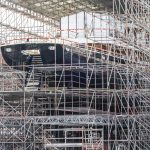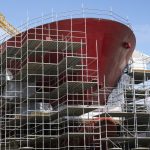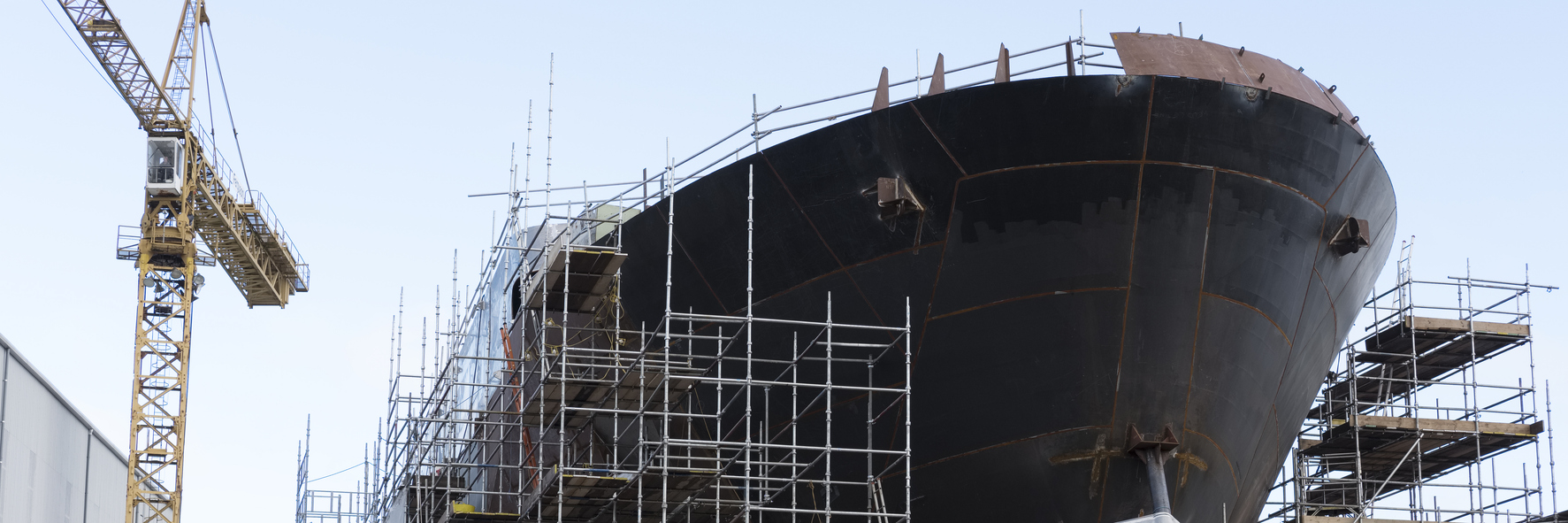
Engineers are to shipbuilding as the keel is to the hull. They are involved in almost every area - from design and project planning to offshore projects and material selection. But engineers alone do not build a ship. What they plan and coordinate must be realised by experienced craftsmen and technicians. This is exactly where Polish specialists come into play. We provide the personnel who turn the engineers' plans into real, floating constructions.
What exactly do naval architects do?
Engineers for shipbuilding and marine technology are involved in the manufacture of all types of watercraft - from inland waterway vessels to ocean liners. They are also involved in the construction of oil rigs and other offshore facilities.
Shipbuilding is fundamentally different from other industries. In the automotive industry, a vehicle is developed and then produced thousands or even hundreds of thousands of times. In shipbuilding, on the other hand, often only a few or even a single unit of a type is built. And even if more than one unit is planned, long construction times and different customer requirements mean that one unit is often only 80 to 90 per cent identical to another. The remaining 10 to 20 per cent must be planned and implemented individually - each time anew.
This means that engineers work out a separate detailed design for each ship. Not only the ship as a whole is planned, but also the hull, superstructure, equipment and components individually - and finally put together.
Why is coordination a key task?
Coordination is a central part of engineering work. Which parts - especially those with long lead times - have to be ordered and when do they have to be available? In what order are they installed?
A strict sequence must be adhered to in shipbuilding. A huge engine can no longer be installed in a ship if the hull and superstructure have already been completed - there will no longer be any access points that are large enough. Engineers therefore plan precisely: the engines must be delivered when the engine room is finished enough to accommodate them - but not so far that it is already closed off.
They monitor the production process to ensure that the gigantic puzzle of thousands of individual parts is assembled in the correct sequence. They are present during assembly and monitor the delivery, handling and insertion of the components. And they coordinate both operating resources and the deployment of personnel.
How are refurbishments and repairs carried out?
Engineers also plan and supervise conversion and repair work on existing ships - with their own challenges. It is often not enough to simply install new parts. Power supply, system connection, communication between systems and sufficient space for installation must be ensured. Each piece of the puzzle is a puzzle in its own right.
There are also technical requirements for connections: They must be watertight, but at the same time allow openings - for pipes for ventilation and fuel transport, for cables for power supply, for the shaft from the engines to the propellers and for hull openings that are needed for cooling the engines, for fresh water extraction from seawater or for draining service water, for example. All of this has to be planned and realised - and the ship has to remain watertight even in the heaviest storms.
When errors occur - which is inevitable with such complex constructions - engineers have to react immediately and on site: Creating connections that were not planned, trimming edges, plugging holes or making new ones.
Why are customer communication, costing and tendering important?
Engineers are also active externally. They talk to clients, understand their requirements and contribute ideas during the negotiation phase that move the project forward. Their goal: to give the customer what they want - as efficiently, safely and environmentally consciously as possible.
They also calculate the project costs, process documents for tenders and prepare customised offers. A broad task - and one that only works if the implementation level runs smoothly.
Who realises the engineers: Craftsmen and technicians from Poland
What engineers plan, craftsmen and technicians have to realise. And it is precisely at this point that German shipyards and suppliers face the greatest shortage of skilled labour. Polish personnel close this gap - available at short notice, with solid technical qualifications and familiar with European standards.
We provide all the specialists from Poland that engineers need to realise their plans:
- Skilled worker for surface treatment and coating - for corrosion protection and final treatment
- Welder (MAG, TIG, E-hand) - for joining fuselage segments, superstructures and components
- Shipbuilding construction mechanic - for the manufacture and assembly of ship structures
- Pipe fitters - for all breakthroughs, pipes, pumps and valves
- Industrial mechanic - for machine installation, maintenance and repair
- Ship mechanic - for propulsion systems and their ongoing control
- Electricians and electrical engineers - for on-board installations, power supply and control systems
- Fitter and metalworker - for hull construction, module construction and fine assembly
Request shipbuilding specialists from Poland
Let us know what you need - we'll get back to you within 24 hours with suitable candidates.
FAQ: Polish specialists for the realisation of shipbuilding engineering projects
Which specialists from Poland are most important for the realisation of shipbuilding constructions?
Welders, construction mechanics and pipe fitters are the three core professions that are most frequently in demand for the realisation of engineering planning in shipbuilding. We reliably cover all three professional groups from our network in Poland.
Can Polish craftsmen also be used for remodelling and repair projects?
Experienced Polish metalworkers, welders and pipework fitters are also well-suited to conversion and repair work. The technical requirements – making connections, creating openings, adapting systems – are exactly what our candidates are familiar with from their many years of project experience.
How does the co-operation between Polish craftsmen and the engineers on site work?
Polish specialists work according to specifications and under the supervision of the project engineers - this is standard for assignments of this type. If required, we recommend German-speaking foremen or team leaders, who we can also provide on request.
For which contract models are Polish specialists available?
Temporary employment (AÜG) for flexible short-term requirements, contracts for work and labour for clearly defined trades and secondment for longer project assignments. We can advise you on which model suits you best.
How quickly can skilled workers from Poland be ready for deployment?
For standard profiles within 7 days. For specialised qualifications or larger teams, we recommend 2-3 weeks lead time.
What is included in your complete package?
Candidate selection, transport, accommodation, catering, work permits, A1 certificates and all other formalities. You concentrate on your project - we take care of everything else.