Shipbuilding engineers are among the most demanding professions in engineering. They plan complex designs over months and years, coordinate hundreds of trades and react in real time to technical problems on site. What they design must be precisely realised by experienced craftsmen. It is precisely at this point that German shipyards and suppliers have the greatest need for personnel - and this is where we supply Polish specialists who can reliably take on this task.
What training and formal qualifications are required of naval architects?
If you want to become an engineer for shipbuilding and marine technology, you need a degree in this field. For management positions and for jobs in science or research, a Master's degree, doctorate or habilitation is also expected.
Special rules apply to foreign qualifications: Engineers from abroad with an equivalent professional qualification can, in principle, carry out the activity - however, they may not use the professional title „engineer“ or „consulting engineer“ as long as they cannot produce a certificate of equivalence for their qualification. This certificate can be requested from the State Chamber of Engineers, the regional councils or the district governments.
What are the personal requirements?
In addition to formal training, personal qualities play a decisive role. Shipbuilding engineers should have an interest in organisational and testing activities - monitoring production in a shipyard, planning assembly based on design drawings and controlling operational warehousing are all part of daily business.
Equally important is the ability to think theoretically and abstractly. Design offices often advertise with sample plans - this means that engineers draw up sufficiently concrete plans for example projects that give potential clients an insight into the shipyard's possibilities. On this basis, engineers guide clients through design variants and have already calculated important values such as loading capacity, range and achievable speed - without having a concrete ship or model in hand, solely on the basis of design drawings, experience and estimates.
Once a design has been selected and has materialised into a complete construction plan, further calculations are carried out: static loads, hydrodynamic forces, stability values. All of this usually takes months, often even more than a year. In addition, there are change requests from the client and legal changes for safety and environmental protection. A constant cycle of theory, practical experience and abstraction - if you don't keep up with this, you are unlikely to achieve top performance.
One example: What a seemingly small change triggers
A concrete example helps to illustrate the complexity of this planning work: a yacht was built as a single vessel. A new client orders the same design - only with a larger owner's cabin, more range and more engine power for higher speeds.

What does this mean for the engineers? The decks have to be redesigned to accommodate the larger cabin. Larger engines have to be installed for more engine power - they not only need more space, but also more fuel supply and a more powerful ventilation system. At the same time, the statics have to be right: The fuselage must be reinforced to support the increased weight and power.
Then comes the desire for more range. Larger engines consume more fuel - so more range means twice as much fuel. The tanks have to be significantly larger and will be considerably heavier when full. This means that the statics have to be calculated again and the hull adapted. And it must be ensured that the centre of gravity and centre of gravity remain in balance - so that the ship floats upright even in waves and does not lean to one side.
This last problem is not a theoretical one. The ocean liner Imperator, which transported passengers between Europe and the USA in the early 20th century, regularly tilted to one side - because the ratio between its centre of gravity and centre of gravity had been calculated incorrectly. Hence its nickname. Modern shipbuilding engineers know that such mistakes must not happen.
How is the plan put into practice?
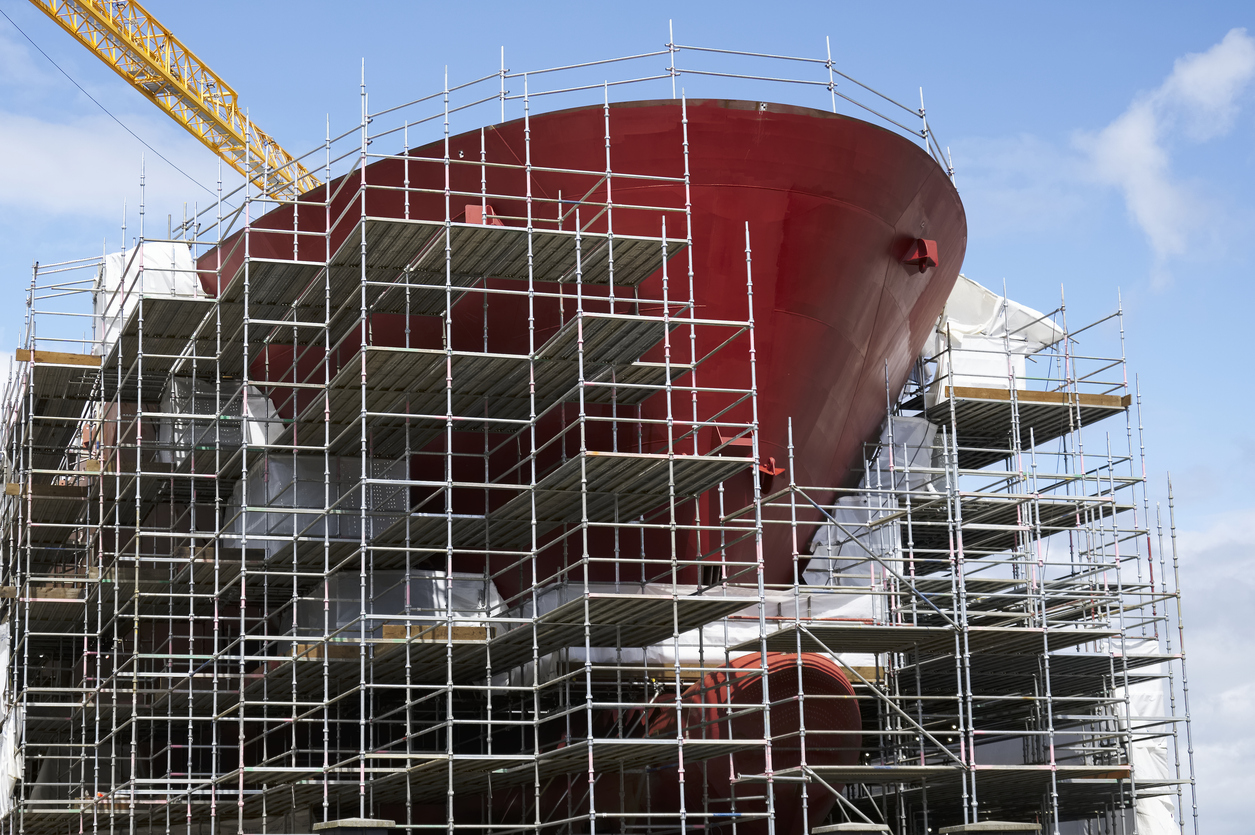
Once the planning phase is complete, the construction of the various assemblies and their composition begins - a truly gigantic puzzle. This is where the craftsmen come into play. What engineers have spent months thinking through and drawing must now be realised precisely and in the right order by welders, fitters, pipework fitters, electrical engineers and mechanics.
And this is precisely the core problem for German shipyards: Engineers are available - or at least easier to find than craftsmen. There is a widespread lack of qualified skilled workers to realise the plans. Polish skilled labour reliably fills this gap.
Which skilled workers from Poland do we recruit for shipbuilding engineering projects?
We provide all the skilled and technical personnel from Poland that shipbuilding engineers need to realise their projects:
- Skilled worker for surface treatment and coating - for corrosion protection and final treatment
- Welder (MAG, TIG, E-hand) - for joining fuselage segments, superstructures and components
- Shipbuilding construction mechanic - for the manufacture and assembly of ship structures
- Fitter and metalworker - for hull construction, module construction and fine assembly
- Pipe fitters - for all breakthroughs, pipes, pumps and valves
- Industrial mechanic - for machine installation, maintenance and repair
- Ship mechanic - for propulsion systems and their ongoing control
- Electricians and electrical engineers - for on-board installations, power supply and control systems
Request shipbuilding specialists from Poland
Let us know what you need - we'll get back to you within 24 hours with suitable candidates.
FAQ: Polish craftsmen for the realisation of shipbuilding projects
Can Polish craftsmen work directly from construction drawings?
Experienced welders, construction mechanics and metalworkers from Poland are accustomed to working from technical drawings. Briefing on project-specific details is usually carried out by the responsible engineer or foreman on site.
How does the collaboration with the engineers on the construction site work?
Polish specialists work according to specifications and under the supervision of the project engineers - standard for this type of assignment. On request, we can also provide German-speaking foremen or team leaders from Poland to facilitate communication between the engineer and the execution team.
For which contract models are Polish specialists available?
Temporary employment (AÜG) for flexible short-term requirements, contracts for work and labour for clearly defined trades and secondment for longer project assignments. We can advise you on which model is best suited to your project.
How quickly can skilled workers from Poland be ready for deployment?
For standard profiles within 7 days. For specialised qualifications or larger teams, we recommend 2-3 weeks lead time.
Can you also organise larger teams for new construction projects over several months?
We place both individual specialists and entire teams for long-term assignments lasting several months. The sooner you get in touch, the better we can tailor the selection process and logistics to your project structure.
What is included in your complete package?
Candidate selection and quality checks, transport, accommodation, catering, work permits, A1 certificates and all other formalities. You concentrate on your project - we take care of everything else.