Shipbuilding is not an office job - not even for engineers. Anyone who works in a shipyard needs more than just technical knowledge: They need physical resilience, a head for heights, weather resistance and the ability to move safely in confined, noisy and sometimes dangerous environments. This applies to engineers as well as to the craftsmen who do the actual construction work. The Polish specialists we recruit bring this resilience with them from many years of practical experience on construction sites and in industry.
What do naval architects do?
The idea that a naval architect sits in an office all day is only partly true. Engineers are also needed on site - on ships, in partially completed structures, in dry docks. They don't just stand on the bridge or at the edge of the dock. They have to find their way up steep stairs, through narrow corridors and even narrower hatches. This requires physical fitness and a confident demeanour in difficult terrain.
Much of the work involved in ship construction takes place outdoors. Engineers have to supervise and coordinate - whatever the weather. Rain, wind and cold are part of everyday life in a shipyard. If you can't cope with this, you quickly reach your limits.
Why is a head for heights essential?
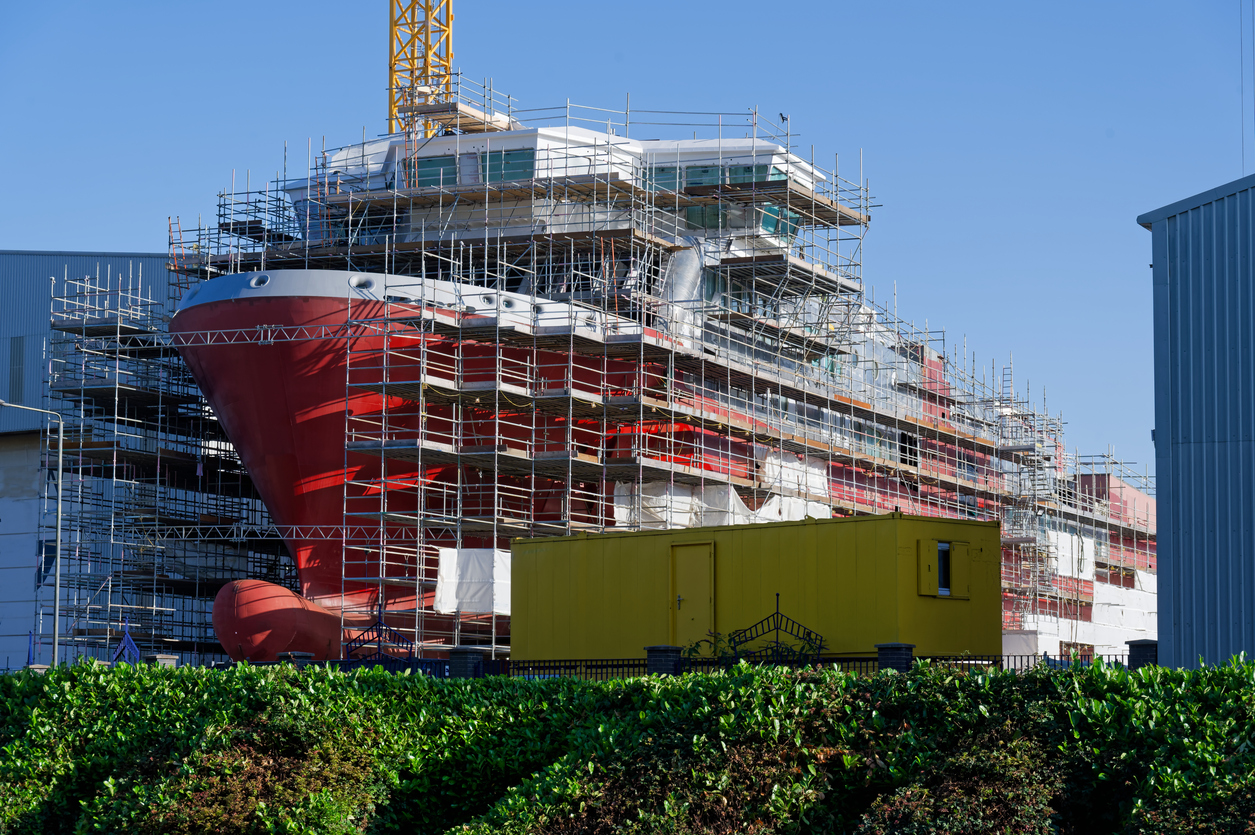
Ships are big - really big. If you've never stood right next to an ocean liner, it's easy to underestimate what that means for your work. Dry docks have high walls, ships' sides tower high into the air, cranes tower over everything. Engineers have to regularly visit these heights to monitor the ongoing construction. Anyone prone to vertigo is out of place in this profession.
The same applies to the craftsmen at the shipyard - welders, metalworkers and fitters work at great heights, on scaffolding and in dry docks. Resilience and a head for heights are daily requirements there. Polish skilled workers from the industrial and plant construction sector are used to these conditions.
What other skills does an engineer need?
An engineer also needs a sure instinct. They have to produce precise design drawings, set up scaled-down test facilities and assemble and test ship models. This is manual work - not just office work.
Good near vision is also required - whether with or without glasses is irrelevant, what is important is the ability to work on a screen with 3D software. Equally crucial is well-developed spatial vision: only those who correctly assess dimensions can safely monitor and coordinate the construction of ships and maritime installations.

It's rarely quiet at a shipyard. Employees come with questions, problems have to be solved on site - in the midst of noise and operation. Engineers must be able to hear and understand words even in a noisy environment. The same applies to craftsmen: clear communication in a team is vital in a shipyard - literally.
What health conditions might make it difficult to work or prevent you from working altogether?
Some health restrictions can make it considerably more difficult or impossible to work in shipbuilding - including those that do not appear obvious at first glance:
Susceptibility to infection or chronic infections are an obstacle to working outdoors. Engineers also have to work in unroofed yards in adverse weather conditions. Office and planning work remains unaffected.
Restrictions of the extremities can be a reason for exclusion. Engineers have to set up test facilities and models, produce design drawings and work manually - this requires full mobility and the ability to function. This applies even more to craftsmen: welding, locksmith work and assembly are physically intensive activities.
Dizziness excludes from many activities. Ships are large, docks are high, and work regularly takes place at great heights.
Non-correctable visual impairment excludes working with CAD software and 3D design programmes - and thus essential parts of engineering work.
Metabolic diseases and chronic stomach or intestinal disorders are the least obvious, but potentially very limiting factors. In shipbuilding, work is often done in shifts - working hours are constantly changing. Those who struggle with metabolic problems or gastrointestinal disorders find it difficult to adapt to these changing times, sleep irregularly and suffer from exhaustion more frequently. This significantly impairs performance.
Why are Polish temporary workers the perfect solution?
The physical demands in shipbuilding are high - for engineers as well as for craftsmen and technicians. The Polish specialists we place are used to these demands from many years of working in industrial, plant and mechanical engineering. Shift work, outdoor work in all weathers, working at height and physically intensive assembly work are part of their everyday working life - not new territory.
We recruit resilient skilled workers from Poland for all craft and technical trades in shipbuilding:
- Skilled worker for surface treatment and coating - for corrosion protection and final treatment
- Welders (MAG, TIG, manual electric) - also for work at height, in confined spaces and under the influence of the weather
- Fitter and metalworker - for hull construction, module construction and assembly work under real conditions
- Shipbuilding construction mechanic - for the manufacture and assembly of ship structures
- Pipe fitters - for pipes, pumps, valves and system breakthroughs
- Industrial mechanic - for machine installation, maintenance and repair
- Electricians and electrical engineers - for on-board installations and control systems
Request resilient shipbuilding specialists from Poland
Let us know what you need - we'll get back to you within 24 hours with suitable candidates.
FAQ: Physical requirements in shipbuilding - Polish skilled labour
Are Polish craftsmen used to physically demanding working conditions in shipyards?
Polish skilled workers in the industrial, plant and mechanical engineering sectors are accustomed to shift work, outdoor assignments in changing weather conditions and physically demanding assembly work. These are standard conditions in Polish heavy industry.
Can Polish specialists also be deployed at great heights and in confined spaces?
Yes, provided there are no personal restrictions. When selecting candidates, we also check specific physical requirements such as a head for heights or suitability for working at heights on request.
How do Polish skilled workers deal with shift work and changing working hours?
Shift and alternating shift work is standard in Polish industry. Most of our candidates have many years of experience and are used to irregular working hours.
For which contract models are Polish specialists available?
Temporary employment (AÜG) for flexible short-term requirements, contracts for work and labour for clearly defined trades and secondment for longer project assignments. We can advise you on which model is best suited to your project.
How quickly can skilled workers from Poland be ready for deployment?
For standard profiles within 7 days. For specialised qualifications or larger teams, we recommend 2-3 weeks lead time.
What is included in your complete package?
Candidate selection and quality checks, transport, accommodation, catering, work permits, A1 certificates and all other formalities. You concentrate on your project - we take care of everything else.